
An AI service may look weightless on a screen. Behind it sit semiconductor tools, specialised memory, network switches, cooling systems and an electricity connection. A government or company able to delay one scarce input can influence the entire project.
Computing power becomes geopolitical influence through these dependencies. The most consequential question is often who can delay delivery, narrow access or raise the cost of expansion. That power is distributed across a supply chain; no single country possesses every capability at the same quality, scale and cost.
From a chip design to useful computing
A chip is one component of a working system. Large training jobs require accelerators to communicate efficiently, memory to keep data close to the processors, software that uses the hardware well, and reliable infrastructure around it. Inference—running a trained model—has different workload and cost constraints, and can sometimes use a wider range of hardware.
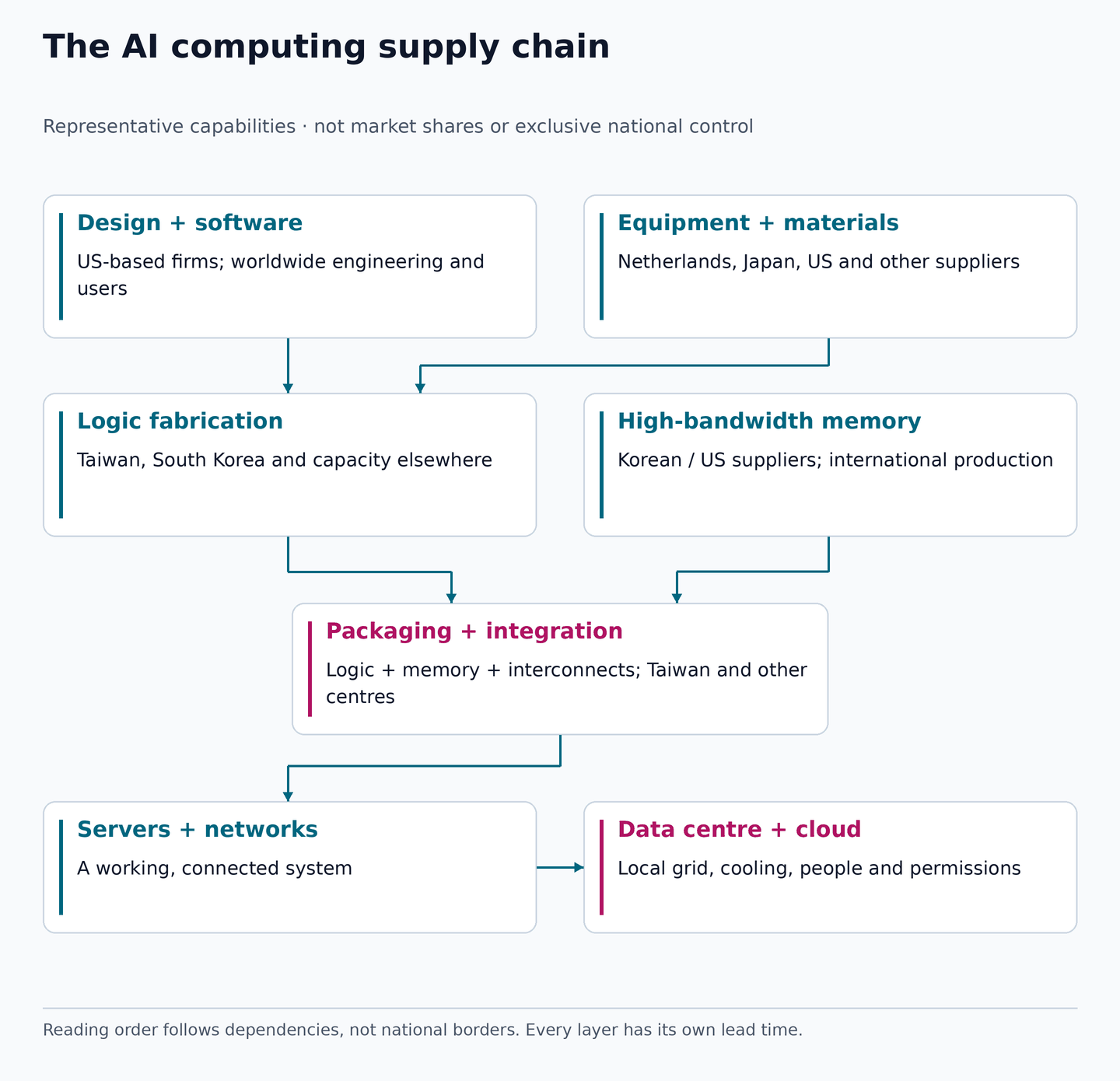
| Layer | Representative geography | Why replacement can be difficult |
|---|---|---|
| Chip design and design software | US-based firms, with engineering and customers worldwide | Intellectual property, verification, software compatibility and engineering time |
| Manufacturing equipment and materials | The Netherlands, Japan, the US and other specialist suppliers | Precision systems, process integration, servicing and supplier qualification |
| Advanced logic fabrication | Taiwan and South Korea, with capacity also elsewhere | Yield, manufacturing know-how, capacity and time to qualify a process |
| High-bandwidth memory | South Korean and US-headquartered suppliers, with international production | Qualified supply, stacking technology and integration with the processor |
| Advanced packaging | Taiwan and other manufacturing centres | Bringing logic, memory and interconnects together at acceptable yield and scale |
| Data-centre operation | Location-specific grids, infrastructure and service providers | Power delivery, cooling, networks, staff and permission to operate |
Representative supplier sources are collected in [5]; they document capabilities and locations, not market shares. These are examples, not a league table or a claim that countries own the firms headquartered there. Corporate ownership, the location of a factory, the origin of a tool and the jurisdiction governing a transaction can all differ.
ASML’s explanation of extreme ultraviolet lithography illustrates the specialised equipment behind advanced manufacturing. TSMC’s 3DFabric materials show why integration and packaging belong in the story alongside transistor fabrication. Neither source implies that every AI workload requires the newest process or the same packaging technology. [1][2]
A chokepoint is a difficult substitute
A high market share alone does not explain leverage. Four questions matter:
- Can the input be replaced? A functionally similar component may still require a board redesign, software changes or extensive qualification.
- How long does replacement take? A possible alternative arriving years later does not solve a capacity shortage this quarter.
- Who can constrain access? A supplier can allocate orders; a government may control licences; a utility can determine the connection schedule.
- What does withholding cost the supplier? Lost revenue, incentives for competitors and retaliation limit the power of restriction.
Those questions explain why memory, packaging or grid equipment can become as consequential as the headline processor. They also explain why influence moves. Investment and substitution can weaken a bottleneck, while rapid demand growth can create another downstream.
Export controls turn technical dependence into policy
Export controls can condition whether a transaction proceeds, which customers receive a product, and what uses are permitted. In the US system, the relevant analysis can involve the item’s classification, destination, end user, end use and applicable restrictions on exports, reexports or transfers. Some foreign-produced items can also fall within US rules under specified conditions. A shipment’s departure country alone is therefore insufficient. Being subject to the EAR also does not mean that every transaction requires a licence: scope and licensing are separate tests. [3]
Controls can apply to advanced computing items, manufacturing equipment or particular entities and uses. Their effect depends on the exact rule, exceptions, licences and enforcement. “AI chips are banned” is usually too broad a description to explain a real transaction.
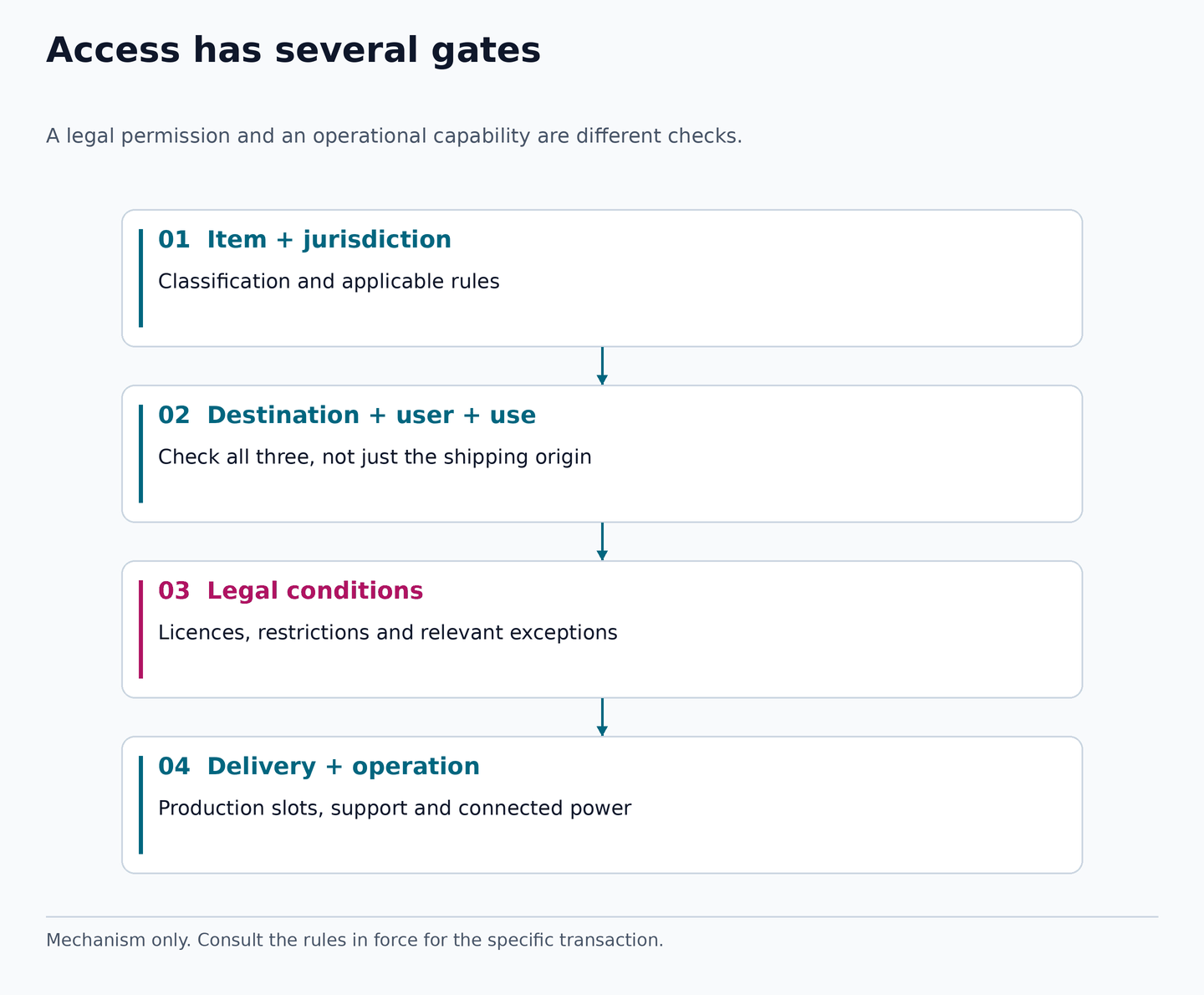
Restricting a tool can affect future manufacturing capacity as well as today’s shipments. Restrictions involving parts, software or servicing may affect equipment over its operating life, depending on the measure. By contrast, controlling a finished accelerator may constrain near-term deployment without instantly eliminating the recipient’s research capability.
The strategic aim can include slowing sensitive capabilities or preserving a technological advantage. The outcome is conditional. Restrictions can impose costs and delay, but also encourage domestic alternatives, redesigns, efficiency improvements and new supply relationships. Effective analysis separates a policy’s stated objective from evidence of its actual effect.
Cloud access is a separate dependency. Renting compute abroad can reduce the need to own a local cluster. It introduces questions about provider policies, jurisdiction, data access and continuity of service. It is not a universal escape from controls: the applicable law and service restrictions still need to be checked. Nor does a chip restriction automatically tell us which cloud services are lawful.
Electricity determines where the system can run
Power demand is a physical constraint with local consequences. A data-centre developer needs an available connection, transmission and distribution capacity, cooling, backup arrangements and reliable supply. A national surplus of generation does not prove that a particular site can be energised on schedule.
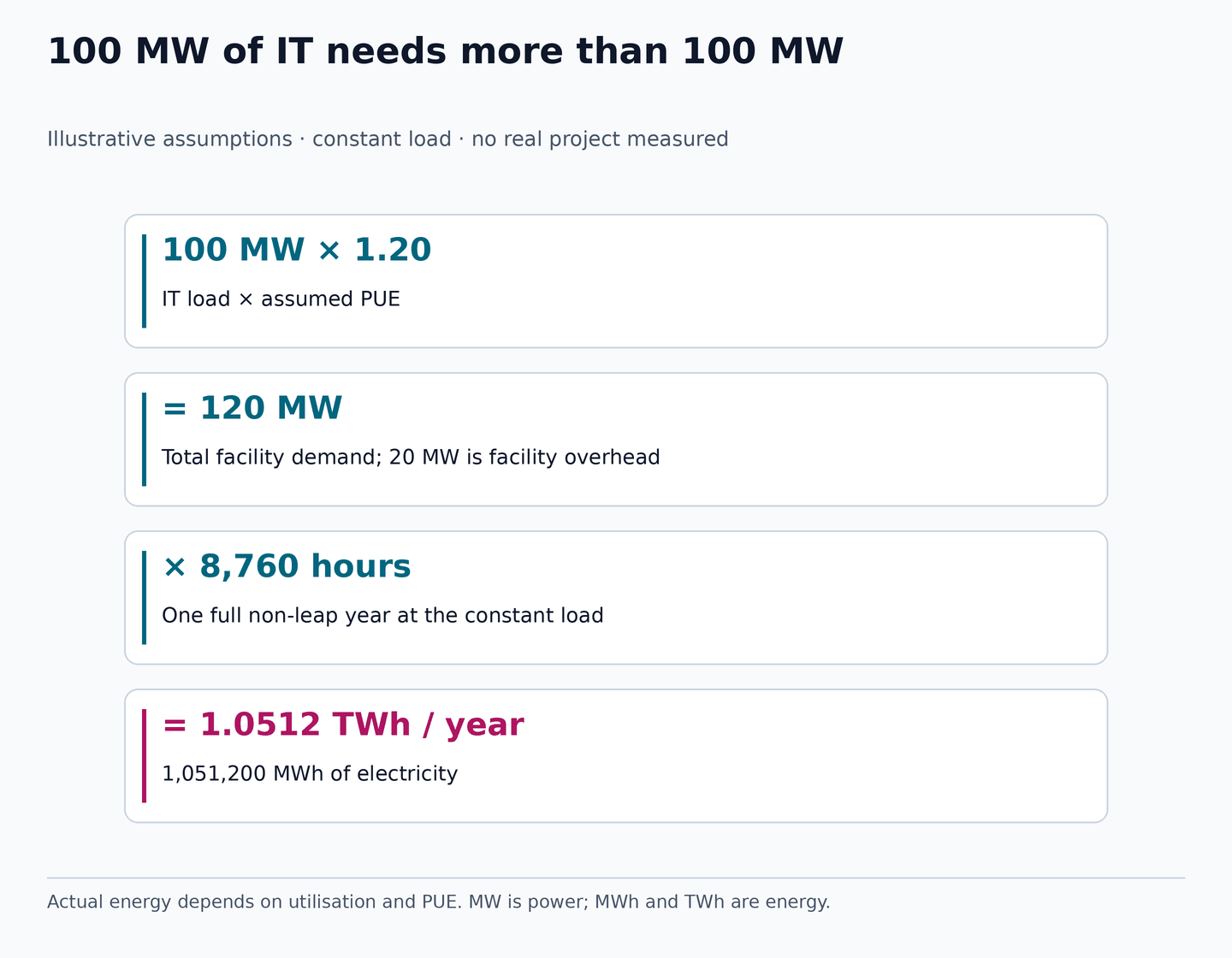
Here is an illustrative calculation, not a measurement of a real project:
| Assumption or result | Value |
|---|---|
| Constant IT equipment load | 100 MW |
| Assumed power usage effectiveness (PUE) | 1.20 |
| Total facility load: 100 × 1.20 | 120 MW |
| Annual electricity at that constant load: 120 × 8,760 | 1,051,200 MWh, or about 1.05 TWh |
PUE is total facility energy divided by IT equipment energy over the same period. The extra 20 MW in this example covers facility overhead; it is not all necessarily cooling. Actual annual consumption depends on utilisation, PUE and operating conditions. MW describes power; MWh or TWh describes energy over time.
The IEA’s Energy and AI examines this connection between computing and the electricity system. Its scenarios should be read with their publication dates and assumptions; projected growth is not observed consumption. [4]
A renewable power-purchase agreement can support procurement goals. It does not, by itself, establish local grid capacity or a physically matched clean supply in every hour. Equally, a low electricity price can be offset by delays, poor reliability or limited network connectivity. Countries compete through the whole operating environment.
What Japan can influence
Japan’s role extends beyond hosting cloud regions or buying accelerators. Its semiconductor equipment and materials capabilities connect it to production elsewhere. Its industrial-policy choices concern which capabilities to build locally, which partnerships to deepen, and how to supply factories and data centres with dependable energy.
Japan’s May 2026 FOIP update makes the connection explicit: its first priority area links economic infrastructure for the AI and data era with resilient energy and critical-material supply chains. That is a statement of direction, not evidence that all the required capacity has been built. [6]
That creates three connected tests:
- Industrial capacity: does an investment produce a qualified, economically usable capability, or only an announcement and a building?
- Energy capacity: can the location support the demand without leaving connection schedules, local prices and reliability as unresolved assumptions?
- Access and dependence: who supplies essential tools, software and components, and who can change the conditions under which they remain available?
A subsidised fab may improve resilience while still depending on overseas tools and customers. A domestic data centre may improve operational control while relying on imported accelerators and foreign software. Sovereignty has degrees: ownership, operating authority, access to updates, knowledge and replacement capability each answer a different question.
Japan’s choices also connect to the maritime fuel system discussed in Japan’s energy security starts at sea. Where additional electricity relies on imported fuel, the compute supply chain inherits part of that exposure. The relationship changes with the generation mix and with where and when the new load operates.
How to judge the next AI infrastructure announcement
Ask what has actually been secured: chips ordered or delivered; memory and packaging allocated; licences obtained where required; power requested or connected; a facility built or producing useful work.
Then look for the least replaceable remaining dependency. More accelerators cannot compensate for an unpowered building. More power cannot compensate for an unusable software stack. An export licence cannot guarantee a production slot.
The countries and companies with durable influence will be those that can provide scarce capabilities reliably—and adapt when customers find alternatives. AI competition is therefore also a contest over manufacturing depth, dependable infrastructure and the terms on which others can use them.
Sources and further reading
- ASML, EUV lithography systems. Manufacturer explanation of a specialised stage of advanced chip production.
- TSMC, 3DFabric. Manufacturer explanation of integration and advanced packaging technologies.
- US Bureau of Industry and Security, Export Administration Regulations. See 15 CFR Part 734, especially §734.9, on scope and foreign-direct-product rules, and Part 738, especially §738.4, on licence determination. Reviewed 5 November 2026; a specific transaction requires its own checks.
- International Energy Agency, Energy and AI. Published 10 April 2025. See the full report, the PUE discussion on page 54 and the grid-constraints discussion in section 2.6. Scenarios are not measurements.
- Representative manufacturer sources, checked 5 November 2026: Synopsys design tools and IP; Tokyo Electron equipment and Applied Materials; TSMC manufacturing locations and Samsung foundry sites; Samsung HBM and Micron HBM. These are supplier descriptions, not independent market-share estimates.
- Japan’s Ministry of Foreign Affairs, Updated FOIP, May 2026 summary, Area 1, PDF page 4: AI/data infrastructure and energy/critical-material supply-chain resilience.
Editorial scope: a structural analysis, not a current licensing matrix or a forecast of a specific country’s AI capability. Country labels are representative; the electricity example is explicitly hypothetical.