
A tanker delayed thousands of kilometres from Japan can matter to a factory in Aichi or an electricity customer in Tokyo. The link runs through a chain of contracts, vessels, ports, storage tanks and power plants. A country can have money to buy energy and still struggle to obtain the right cargo, in the right place, at the right time.
That is why Japan’s energy policy reaches far beyond its power stations. Relationships with Gulf producers, cooperation with Southeast Asian coastal states, investments in Australian gas and the security of maritime trade all affect its room to manoeuvre.
This is a guide to those structural connections. It distinguishes physical availability, delivery reliability and affordability. A price shock can hurt Japan even when every ship arrives.
Two imported fuels, two different risk maps
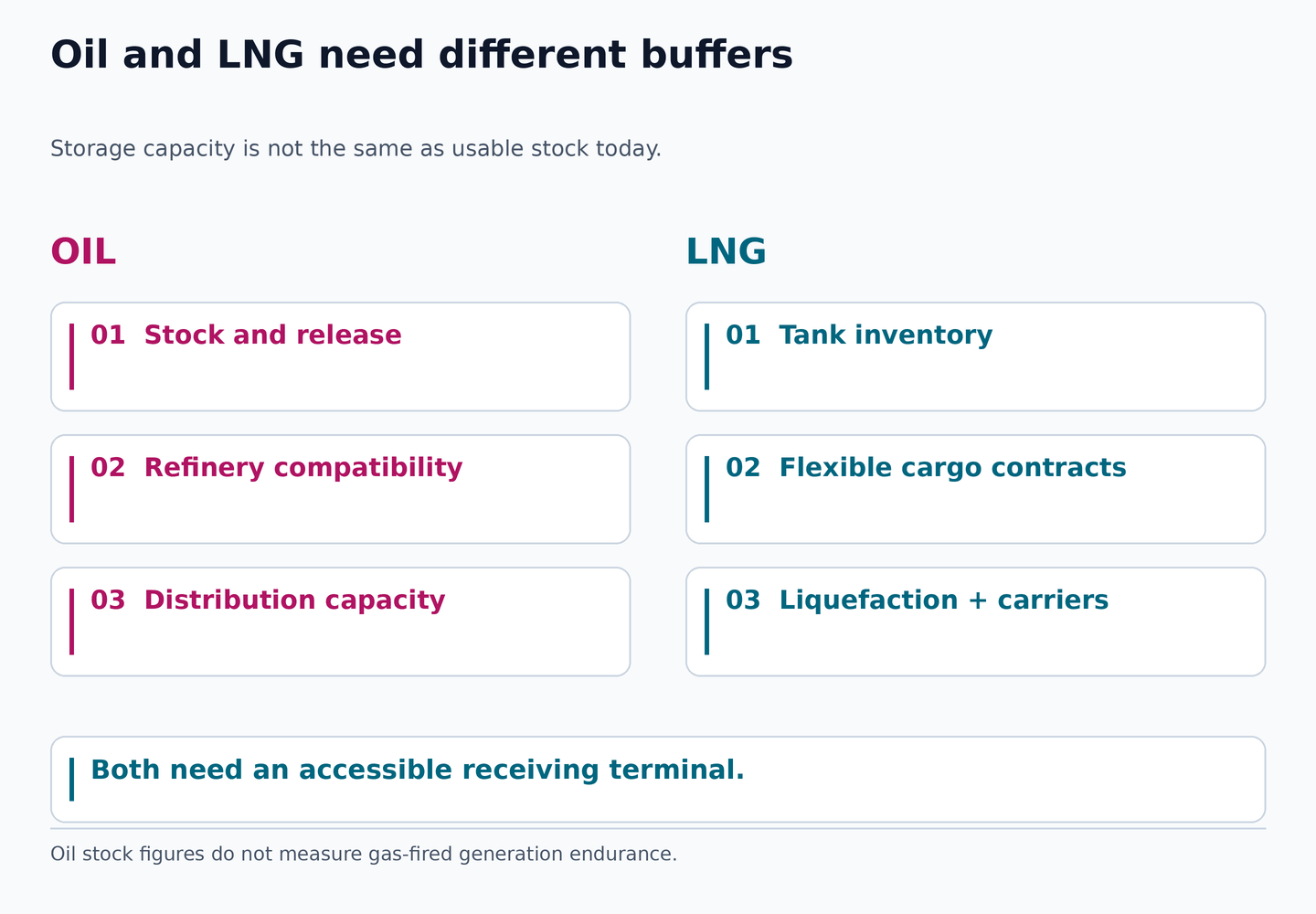
Oil and liquefied natural gas are often bundled together as “energy imports”. Their vulnerabilities differ.
A dated baseline makes the difference clear. The EIA’s Japan brief, published in July 2023, reports that 93% of Japan’s crude imports came from the Middle East in 2022. Its LNG imports had a different geography: Australia supplied 42% and Malaysia 17%. These are historical 2022 shares, not estimates of the November 2026 mix. The denominators matter too: a share of crude imports is not a share of all energy used in Japan. [1]
| Question | Oil | LNG |
|---|---|---|
| What arrives? | Crude for refining, alongside separately traded petroleum products | Natural gas cooled into liquid for transport, then regasified |
| Where does concentration arise? | Supplier geography, export terminals and shared shipping routes | Liquefaction plants, specialised carriers, contracts and receiving terminals |
| What provides a buffer? | Commercial and strategic stocks, subject to type, location and release capacity | Storage and flexible cargo procurement, constrained by tank capacity and delivery schedules |
| How easy is substitution? | Alternatives must fit refinery requirements and transport arrangements | A replacement requires available gas, liquefaction, a vessel, a berth and commercial permission |
LNG is stored at cryogenic temperatures. Its inventory economics and infrastructure differ from oil storage; an oil-stockpile headline cannot establish how long a gas-fired power system could operate. Neither does an LNG terminal’s nominal capacity tell us how much usable gas is in its tanks today.
Read the route before reading the headline
For a cargo loaded inside the Persian Gulf, the Strait of Hormuz sits between its export terminal and the open ocean. Eastbound voyages can then cross the Indian Ocean and pass through the Malacca and Singapore straits towards East Asia. Route choices depend on the vessel, destination and operating conditions. [2]
These are different constraints. Alternative passages through the Indonesian archipelago can change the route around Malacca, with costs in distance, fuel and time. They do not solve a closure that prevents a cargo from leaving the Gulf in the first place. Some regional oil can use pipelines to export terminals outside Hormuz, but such bypass capacity is specific and limited; it cannot be assumed to replace all flows or LNG exports. [2]
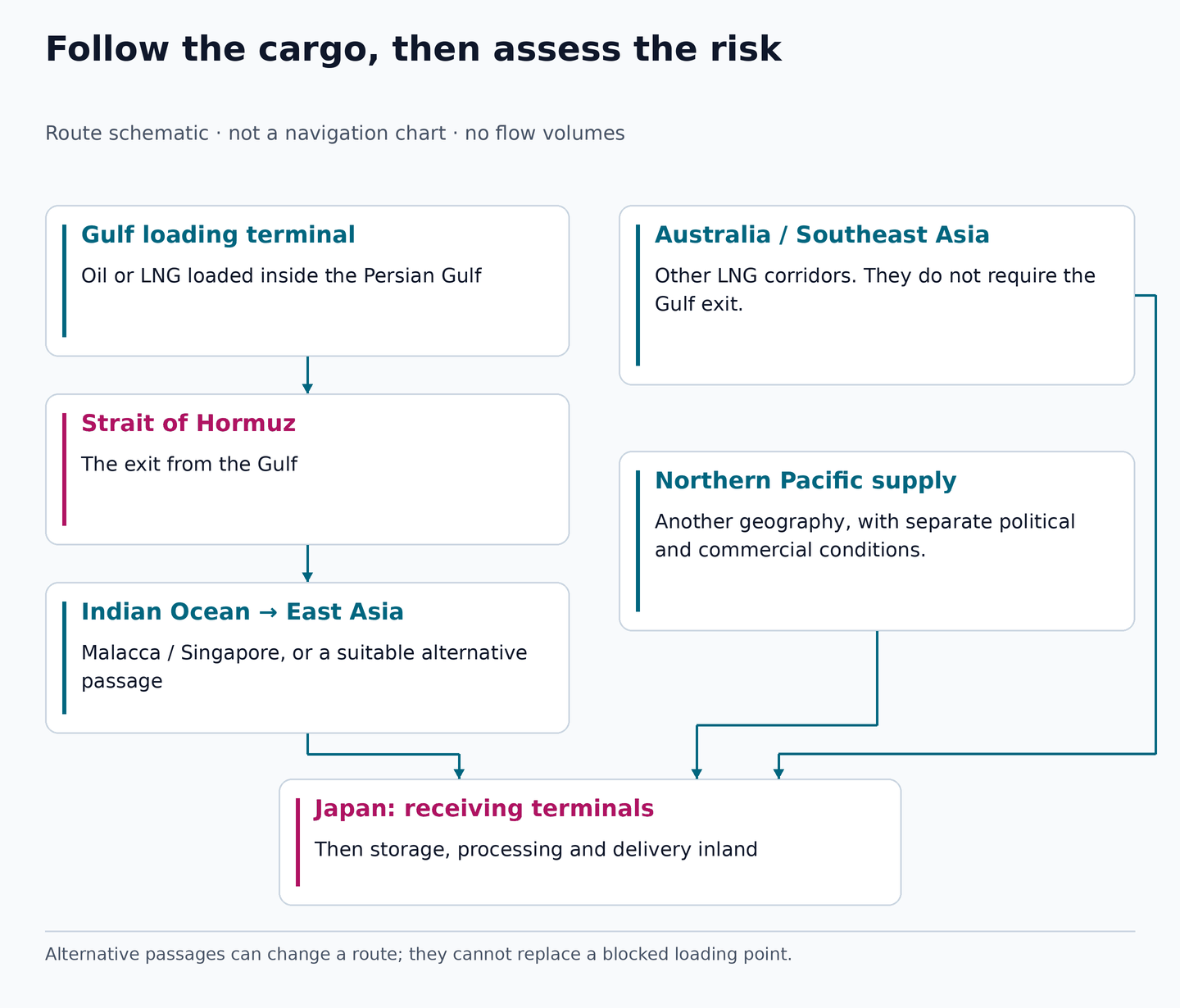
Australia-to-Japan LNG does not share the Gulf exit. Northern Pacific supply offers another geography. Yet geographical diversity alone is insufficient: two different suppliers may depend on the same shipping fleet, commercial counterparty or scarce pool of replacement cargoes.
The Red Sea and Suez also deserve careful treatment. They matter greatly to Asia–Europe trade and to cargoes actually using that corridor. A Gulf-to-Japan voyage heading east does not ordinarily need Suez. Disruption there can nevertheless affect Japan through global freight availability, diverted energy cargoes and prices. Direct route exposure and indirect market exposure are separate questions.
How trouble at sea reaches the electricity bill
A chokepoint does not have to close to impose costs. A credible threat can change insurance terms, crew availability or a shipowner’s willingness to sail. A longer route can reduce the number of cargoes a fleet delivers in a month even when no vessel is lost.
Consider an illustrative disruption, not a forecast: several LNG cargoes are delayed while other importers also need replacements. A Japanese buyer with flexible supply and available tank inventory has options. A buyer relying on a tightly scheduled delivery may have to bid for a spot cargo, adjust generation or manage demand.
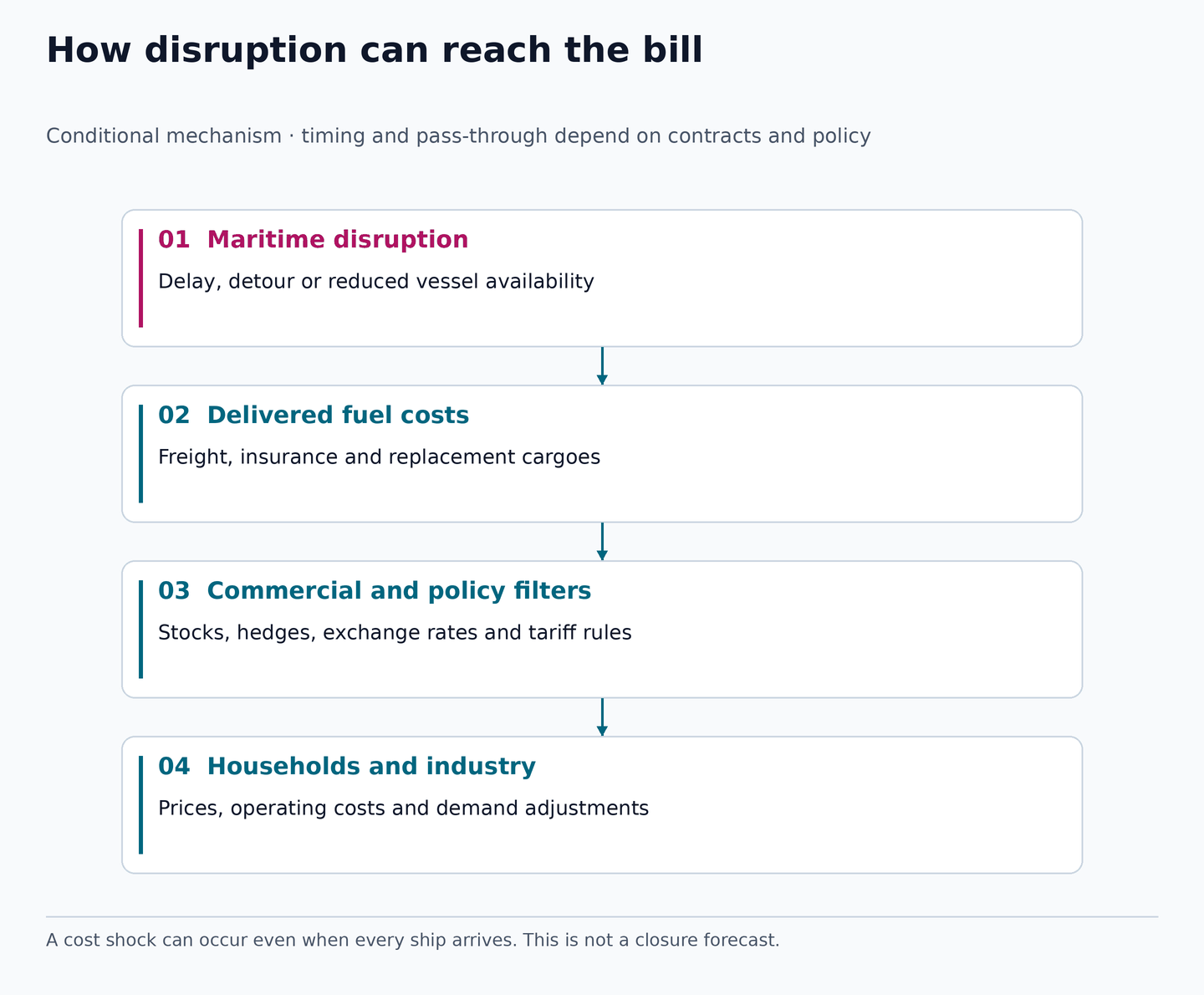
The effect on bills is filtered through contracts, hedges, tariff rules and policy decisions. It is not necessarily immediate or one-for-one. Many energy transactions also involve foreign currency, so a weaker yen can increase the domestic cost of an unchanged dollar price. A company can therefore face higher costs without suffering a physical supply interruption.
Energy security is partly the capacity to absorb a shock without forcing households, manufacturers and public finances into an expensive scramble.
Why this becomes foreign policy
Producer relationships protect access. Long-term commercial relationships, investment and diplomatic engagement can improve information and supply options. They do not guarantee that a terminal remains operational or that a government gives every customer equal treatment during a crisis.
Maritime cooperation protects the system of delivery. Navigational safety, information sharing, coastguard capacity and rules governing sea passage help sustain trade. Japan’s Free and Open Indo-Pacific policy places maritime connectivity and a rules-based order within its broader diplomatic agenda. Energy dependence helps explain why those issues matter, alongside other security and commercial interests. [3]
The government made another connection explicit in its May 2026 update to FOIP: building economic infrastructure for the AI and data era includes stronger supply chains for energy and critical materials. Fuel security and technology policy now appear within the same stated priority. That policy statement does not, by itself, establish that a particular project or shipping route is secure. [3]
Alliances and regional relationships solve different problems. Deterrence and protection of shipping are part of the picture. Port access, local knowledge, commercial insurance and cooperation with coastal states remain essential. A naval presence cannot manufacture a replacement LNG cargo or instantly expand a receiving terminal.
Sanctions create competing obligations. Governments can seek to impose costs on an aggressor while protecting domestic energy supply. Whether a particular cargo, project, payment or service is permitted depends on the applicable rules and date. Proximity to Japan does not remove sanctions or ownership risk. The useful question is which dependencies remain after a legal or diplomatic relationship changes—not whether a supplier is simply “near” or “far”.
Resilience means buying options
More suppliers help most when their failure modes differ. Combining several contracts that all depend on one exposed corridor provides less protection than the contract count suggests.
| Policy lever | What it can improve | What it cannot guarantee |
|---|---|---|
| Supplier and route diversification | Alternatives after a local disruption | Immunity from a global price spike |
| Stocks and emergency arrangements | Time to respond | Indefinite replacement of interrupted flows |
| Flexible contracts and cargo swaps | Ability to redirect or obtain deliveries | Spare global liquefaction or shipping capacity |
| Efficiency and demand response | Less fuel needed for a given service; lower peak pressure | A cost-free or unlimited reduction in demand |
| Domestic low-carbon generation and stronger grids | Lower fuel-import exposure where they displace fossil generation | Instant construction, public acceptance or freedom from other supply chains |
Renewables, storage, interconnection and nuclear generation each involve different costs, schedules and constraints. Their energy-security value depends on what fossil fuel they actually displace and when they can deliver. Nuclear restarts also depend on regulatory decisions and local processes. New domestic infrastructure changes the risk mix; it does not abolish dependence on materials, equipment or specialised expertise.
There is a climate tradeoff too. Emergency fossil-fuel flexibility can reduce the damage from a short disruption, while long-lived investment can create commitments that outlast it. A resilient plan distinguishes temporary insurance from the energy system it wants decades from now.
Five signals worth watching
- Route-specific disruption: identify the loading terminal and actual corridor before assuming every Japanese import is affected.
- Usable inventories: check fuel type, location, delivery capability and the date of the observation.
- Replacement availability: distinguish a cargo that can be bought from one that can physically arrive before stocks tighten.
- Delivered cost: include freight, insurance, exchange rates and contract terms, not just the commodity benchmark.
- Demand and substitution: weather, plant availability, efficiency and grid constraints determine how much flexibility exists at home.
Japan’s strategic advantage comes from having time and credible alternatives when a route, supplier or market becomes unreliable. The ship is only one part of that system—but it is where geography becomes a delivery deadline.
Sources and further reading
- US Energy Information Administration, Japan Country Analysis Brief, updated 7 July 2023. Historical 2022 crude and LNG import shares; see “Petroleum and Other Liquids” and Figure 10. These figures are not a current procurement snapshot.
- US Energy Information Administration, World Oil Transit Chokepoints. Updated 3 March 2026. Geography and constraints of major maritime energy passages; flow figures have separate observation periods.
- Ministry of Foreign Affairs of Japan, Free and Open Indo-Pacific. See the May 2026 policy summary, especially Area 1 on PDF page 4. The energy and AI priority is stated policy; the implications for resilience discussed here are analysis.
Editorial scope: a structural explainer, not a live shipping bulletin, inventory estimate or sanctions determination. All route diagrams are original schematics; line widths do not encode trade volumes.